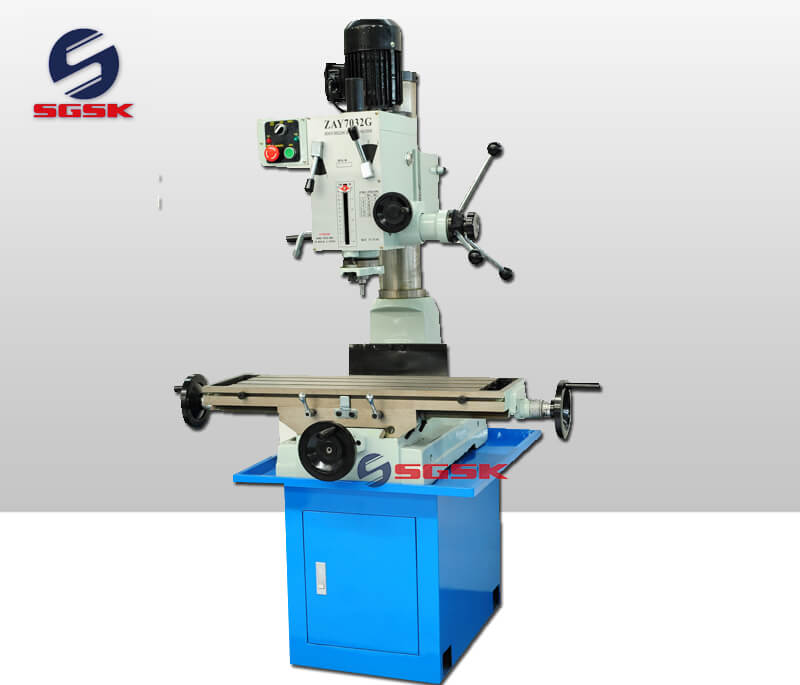
A CNC milling machine for education should give students more than a basic introduction to machine movement. It should provide hands-on experience with CNC programming, workpiece setup, tooling, machining parameters and real metal-cutting processes.
GSK provides industrial CNC machining solutions that can be configured for vocational schools, technical colleges, engineering departments and CNC training centers.
Unlike small hobby or desktop machines, an educational CNC milling machine based on industrial machining-center technology allows students to become familiar with equipment, controls and workflows similar to those used in real manufacturing environments.
A CNC machine used for technical education can support training in several areas.
Students can practice:
● CNC machine startup and operation
● G-code programming
● Work coordinate setup
● Tool offset setting
● Workpiece clamping
● Milling
● Drilling
● Tapping
● Pocket machining
● Contour machining
● Basic CNC maintenance
● CAD/CAM programming
● Toolpath verification
● Machining parameter adjustment
This makes a CNC milling machine for training suitable for programs covering manufacturing technology, CNC machining, mechanical engineering and industrial automation.
Programming is one of the most important parts of CNC education.
Students can use a real CNC machining center to understand how commands affect machine movement and cutting operations.
Training can include:
● G00 rapid positioning
● G01 linear interpolation
● Circular interpolation
● Tool changes
● Spindle control
● Feed-rate control
● Work offsets
● Tool compensation
● Drilling cycles
● Tapping cycles
Practical CNC programming helps students connect theoretical code with actual machine behavior.
Different training environments require different equipment.
Requirement Industrial CNC Training Machine Desktop CNC Real metal cutting Strong Limited Industrial CNC control Available Often simplified Automatic tool changer Available Limited BT40 tooling Available Usually not Vocational training Recommended Introductory Factory skill transfer Strong Limited Production-style setup Yes Limited
For introductory demonstrations, desktop CNC machines may be sufficient.
For vocational schools and engineering programs that want students to develop skills transferable to industrial production, an industrial CNC Vertical Machining Center is generally a more suitable training platform.
The XH7126 CNC Vertical Machining Center provides a practical three-axis configuration for CNC milling training.
It can be used to teach:
● CNC milling
● Drilling
● Tool setting
● Coordinate setting
● Workholding
● CNC programming
● Basic machining-center operation
Its machine size and machining capacity make it suitable for training programs that require real machining experience without starting with a very large machining center.
The VMC640 3-Axis CNC Milling Machine is another option for technical training.
It can support instruction in:
● Three-axis milling
● CAD/CAM toolpaths
● Drilling and tapping
● Fixture setup
● Tool management
● Production-oriented CNC programming
Different CNC controller configurations can also be evaluated according to the training program.
For programs covering larger workpieces or more production-oriented machining, the VMC850 Vertical Machining Center provides another step toward industrial CNC training.
It is better suited to advanced technical education where students already understand basic CNC operation and need exposure to larger machine capacity and production processes.
Modern CNC education should not stop at manual G-code programming.
Students also need to understand how CAD/CAM software connects digital part models with machining operations.
A typical training workflow can include:
Part Drawing → CAD Model → CAM Toolpath → Post Processing → CNC Program → Machine Setup → Trial Cutting → Measurement
This process helps students understand the full manufacturing workflow rather than only individual machine commands.
For education projects, the machine itself is only one part of the solution.
A complete training package may include:
● CNC machining center
● CNC controller
● Tool holders
● Cutting tools
● Machine vice
● Training workpieces
● Programming examples
● Operation manuals
● Maintenance guidance
● Instructor training
Available configurations should be confirmed according to the requirements of each school or training institution.
Typical users include:
Vocational schools
Technical colleges
Polytechnics
Universities
Mechanical engineering departments
Manufacturing training centers
Government technical institutes
Corporate CNC training departments
The appropriate machine depends on curriculum level, available workshop space and the expected depth of practical machining training.
Send GSK information about your training program, student level, preferred CNC controller, available workshop space and required machining subjects.
We can help compare suitable Vertical Machining Center configurations for education and technical training.
Request a CNC Training Machine Recommendation
What type of CNC milling machine is suitable for education?
Three-axis vertical machining centers are commonly suitable for CNC programming, milling, drilling, workholding and CAD/CAM training.
Is an industrial CNC machine suitable for vocational training?
Yes. Industrial CNC machines can provide students with practical experience closer to real manufacturing environments.
Can students learn G-code on the machine?
Yes. CNC training can include G-code programming, coordinates, tool offsets, canned cycles and actual machining.
Which CNC controller should a school choose?
The best controller depends on the training curriculum and the control systems commonly used by local manufacturers.
Can GSK recommend machines for a new CNC laboratory?
Yes. Provide the number of students, training level, available space and curriculum requirements for machine-selection evaluation.
Form Title