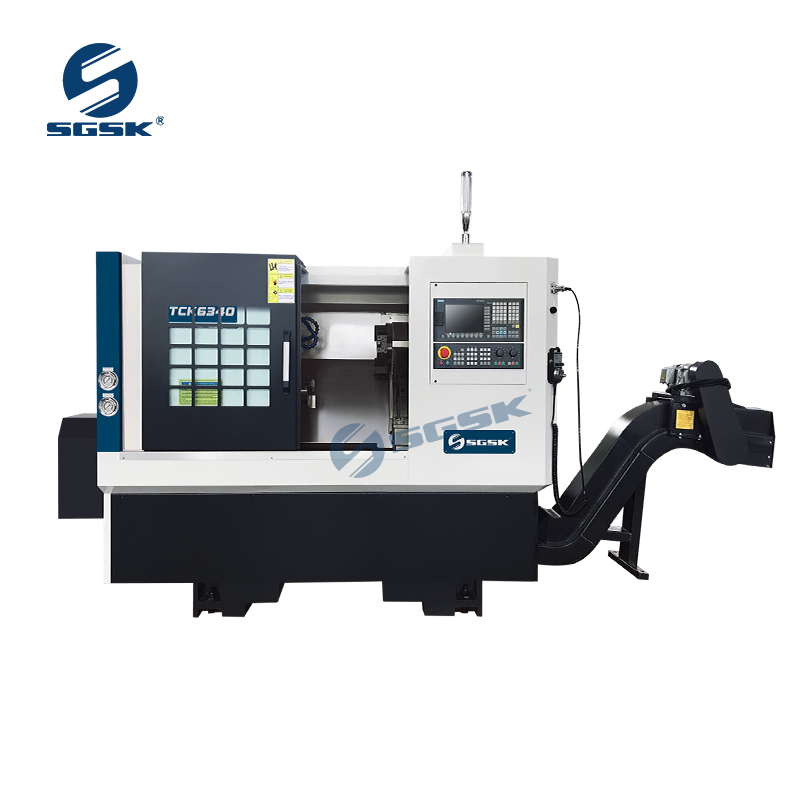
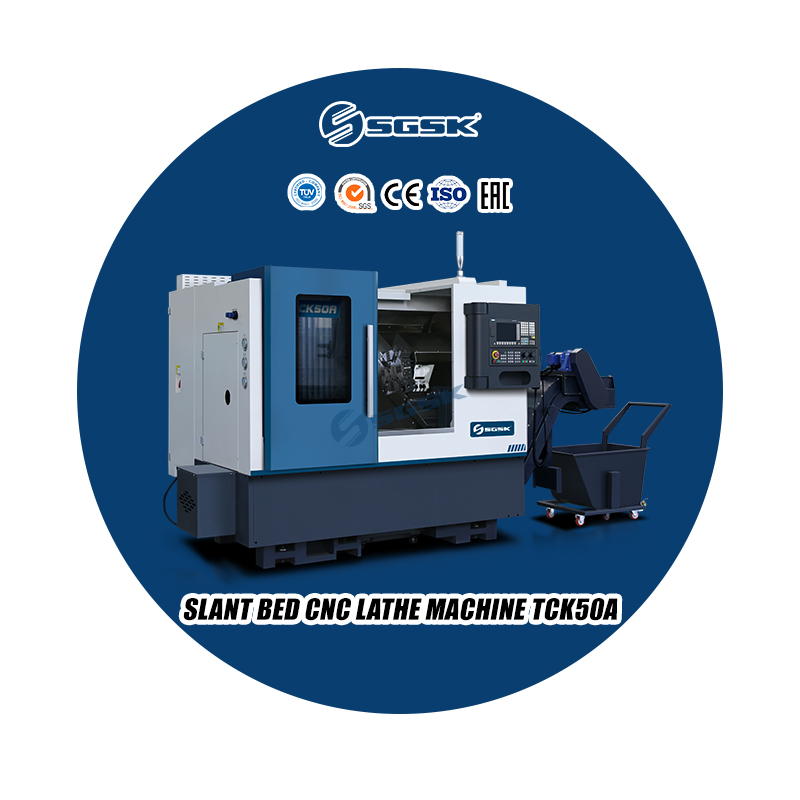
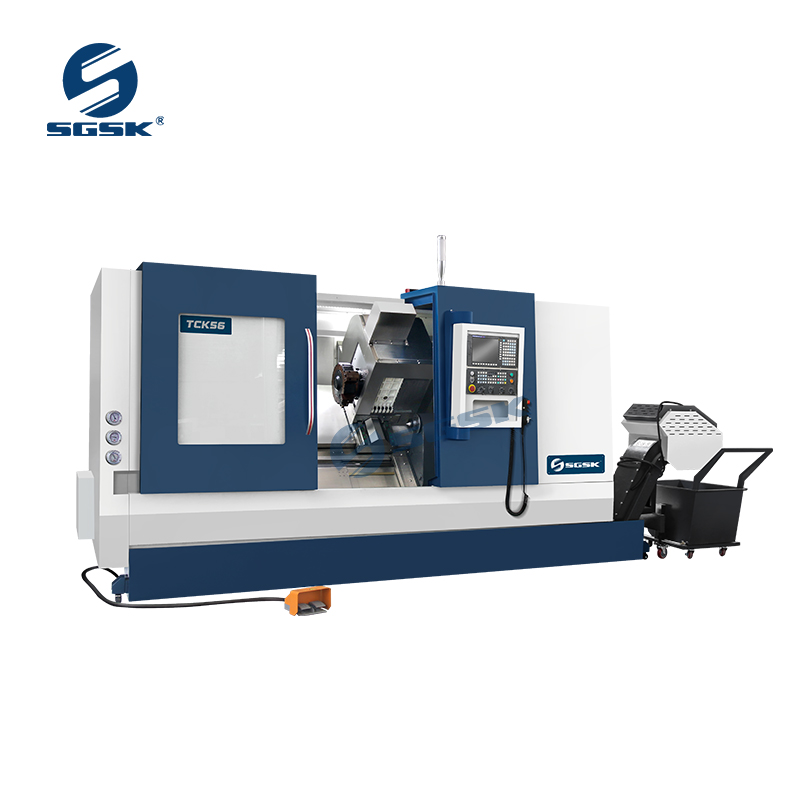
Product Model:
Slant bed CNC lathes are the absolute mainstay of high-precision and high-efficiency machining in modern manufacturing. Through their unique structural design, they perfectly balance the four core requirements of rigidity, precision, chip removal, and automation, making them the preferred equipment for machining complex, precision, and high-value-added parts.
Features
The structural characteristics of a slant bed determine key aspects such as rigidity, chip removal, and precision.
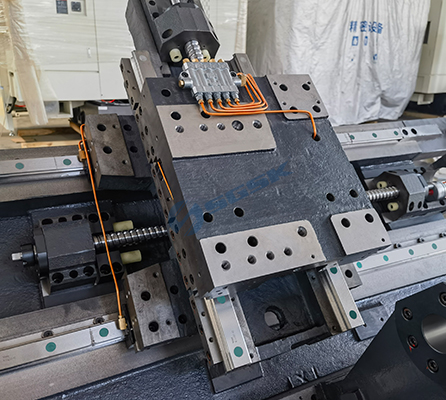
The inclined guideways improve rigidity, for example, by providing a larger cross-sectional area and greater structural stability.
Smooth chip removal reduces interference, which is crucial for automated production.

The slant bed structure (typically with guide rail inclination angles of 30°, 45°, or 60°) is the mainstream design for modern CNC lathes. Compared to traditional flat-bed lathes, it has the following significant advantages:
1. High Rigidity and Stability
Structural Advantages: The bed adopts an integral cast structure. The slanted guide rails allow for a larger bed cross-section and a more compact structure, thus greatly improving the machine tool's rigidity and vibration resistance during cutting.
Result: Enables heavy cutting, maintains high precision, and extends tool life.
2. Smooth and Efficient Chip Removal
Gravity Chip Removal: Due to the slanted guide rails, the chips and coolant generated during cutting naturally slide into the chip conveyor at the front of the machine tool under gravity.
Result: Prevents chip accumulation in the machining area, protects the guide rails and leadscrew, reduces thermal deformation, and improves the continuity and safety of automated production.
3. High Precision and High Stability
Reasonable Layout: Typically adopts a "rear-mounted" or "center-mounted" turret design, the spindle is not affected by turret movement, resulting in a more stable center of gravity.
Drive method: Generally employs a pre-stretched precision ball screw, located close to the guide rail, resulting in high transmission efficiency, precise positioning, and zero backlash.
Result: Maintains micron-level machining accuracy stably over long periods, making it particularly suitable for machining precision parts.
4. Convenient Automation Integration: The inclined bed structure provides naturally convenient space for installing automated units such as automatic chip conveyors, automatic feeders (bar stockers), and robotic arms (robots).
Result: Ideal for building flexible manufacturing cells (FMC) or integrating into automated production lines, making it an ideal choice for achieving "lights-out factories."
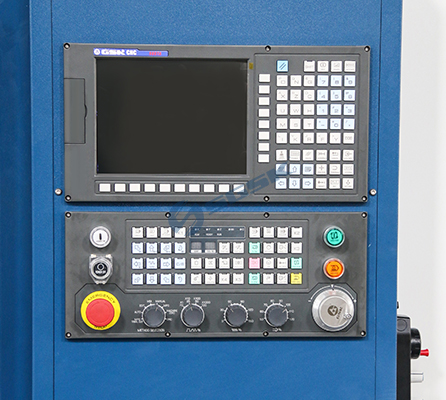
5. Convenient Operation and Maintenance: The operator faces an inclined control panel and machining area, which is more ergonomic, facilitating observation and workpiece loading and unloading.
The machine tool's protective structure design is mature, with good sealing, and maintenance points are easily accessible.
Application
1. Automotive Industry
Typical Parts: Engine shafts, gearbox gears, brake discs, steering knuckles, turbocharger rotors, etc.
Requirements: High volume, high precision, high consistency.
2. Aerospace and Military Industry
Typical Parts: Landing gear components, engine blade tenons, missile casings, hydraulic connectors, etc.
Requirements: Materials are mostly difficult-to-machine alloys (such as titanium alloys, high-temperature alloys), requiring extremely high precision and surface quality.
3. Medical Devices
Typical Parts: Artificial joints (hip joints, knee joints), surgical instruments, stainless steel or titanium alloy implants, dental implants, etc.
Requirements: Good biocompatibility of materials, complex shapes, and extremely high surface finish requirements.
4. Precision Hydraulics and Pneumatics
Typical Parts: Hydraulic valve cores, pump bodies, compressor rotors, precision connectors, etc.
Requirements: High sealing performance, strict geometric tolerances and dimensional accuracy.
5. Electronics and Communications Industry
Typical Parts: Fiber optic connectors, heat sinks, chip cavities, etc.
Requirements: Miniaturization, high precision, and diverse materials (e.g., copper, aluminum, engineering plastics).
6. Mold Industry: Used for machining inserts, cores, etc., of precision molds.
Product Main Technical Parameters
| SPECIFICATIONS | Units | TCK56 | TCK63 | TCK80 |
| Swing over bed | mm | 560 | 630 | 800 |
| Swing over cross slide | mm | 350 | 440 | 600 |
| Max. workpiece length | mm | 500 /1000 | 1000 /1500 /2000 /3000 | 1000 /1500 /2000 /3000 |
| Max. cutting diameter | mm | 350/400 | 440/520 | 660/630 |
| Spindle bore | mm | 65(可选80) | 105 | 105 |
| Spindle nose type | - | A2-6(可选A2-8) | A2-11 | A2-11 |
| Spindle speed steps | - | 无级Stepless | 无级Stepless | 无级Stepless |
| Spindle speed range | rpm | 50-4500(可选3000) | 50-2000 | 50-1500 |
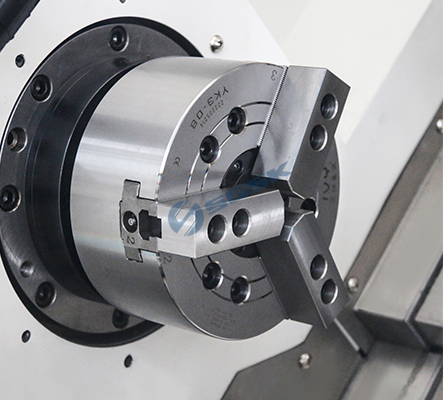
| Chuck | - | 8寸中空液压卡盘 8'' Hollow hydraulic chuck | 12寸中空液压卡盘 12'' Hollow hydraulic chuck | 15寸中空液压卡盘 15'' Hollow hydraulic chuck |
| Turret/tool post | - | 8工位伺服刀塔 Servo turret 8 position | 12工位伺服刀塔 Servo turret 12position | 12工位伺服刀塔 Servo turret 12 position |
| X axis travel | mm | 210 | 270 | 335 |
| Z axis travel | mm | 500/1000 | 1000/1500/2000/3000 | 1000/1500/2000/3000 |
| X axis rapid traverse | m/min | 30 | 12 | 12 |
| Z axis rapid traverse | m/min | 30 | 16 | 16 |
| Main motor power | kw | 11/15 | 15/18.5 | 15/18.5 |
| Tailstock quill taper | - | MT5 | MT5 | MT6 |
| Tailstock base travel | mm | 400/900 | 900/1400/1900/2900 | 900/1400/1950/2950 |
| Guide rail type | - | 45°斜床身线轨 45°Slant bed linear rail | ||
| Machine weight | kg | 3700/4500 | 5000/6000/7000/9000 | 6000/7000/8000/10000 |
Navigation
Tel.: +86 632 5083 879
Mob.: +86 151 6326 5369
Wechat: +86 151 6326 5369
E-mail: info@gskequipment.com
WhatsApp: +86 151 6326 5369