08. 27, 2026
Gantry machining centers are undoubtedly core equipment in the high-end manufacturing field.
Their rigidity, precision, dynamic response, and multi-axis linkage capabilities directly determine the quality ceiling of strategic products such as aerospace structural components,
large-scale energy equipment, and core components for rail transportation. In recent years,
with the accelerated promotion of domestic substitution, the number of domestic gantry machining center manufacturers has surged,
with over 180 new related companies registered in 2023 alone.
However, according to the "China Machine Tool Industry Yearbook (2024)," fewer than 12 companies possess independent R&D capabilities for complete machines,
a self-sufficiency rate of over 40% for key functional components,
and have passed ISO 10791-6 five-axis precision verification.
Beneath the apparent market prosperity lie numerous hidden risks such as "OEM assembly," "falsely labeled parameters," and "delivery followed by shutdown."
Shandong GSK CNC Equipment Co., Ltd., rooted in Tengzhou, the heart of the machine tool industry in southern Shandong
and a county-level city that has been named "China's Capital of Small and Medium-Sized Machine Tools" for 19 consecutive years,
has forged a differentiated path of "emphasizing process, downplaying marketing,
and strengthening verification," supported by a complete casting heat treatment cluster, a precision guideway grinding industry chain,
and over 30 years of experience as a front-line assembly and adjustment engineer.
I. Beware of "High Standards, Low Specifications": Parameter Tables Are Not Acceptance Forms, But Risk Warnings
Currently, some manufacturers emphasize single indicators such as "stroke 8 meters × 3 meters × 2 meters" and "positioning accuracy ±0.008 mm" in their advertising,
while deliberately downplaying key engineering parameters such as the repeatability accuracy decay curve, spindle thermal drift compensation mechanism,
and measured data on beam sag. In 2023, a wind power gearbox factory in Shandong purchased a gantry mill from a certain brand.
After 72 hours of continuous processing, the Y-axis repeatability error widened to ±0.023 mm, resulting in a 17% deviation in tooth profile error and rework losses of 2.1 million yuan.
SGSK Machine Tool Co., Ltd.
implements a "three-stage precision delivery standard" for all its gantry mill models: a 72-hour continuous cutting test in a constant-temperature workshop is completed before delivery;
a "Dynamic Stiffness-Thermal Deformation Coupling Report" issued by a third-party testing agency is provided;
and each machine is accompanied by an independently numbered "Full-Cycle Precision Attenuation Baseline Diagram,"
clearly indicating the measured deviation range of each axis under different loads, temperatures, and operating times.
While this approach extends the delivery cycle by 11 days, the customer's first-year downtime rate is less than 0.8%, far exceeding the industry average of 3.6%.
II. Deconstructing the Myth of "Domestic Production Rate": Self-sufficiency in core components does not equal overall machine reliability
Some companies claim a "95% domestic production rate," but in reality,
they simply integrate purchased Taiwanese spindles, Japanese lead screws, and German linear scales, lacking system-level matching verification.
What truly determines the lifespan of gantry mills are three major coupling relationships: the release of residual stress in the bed castings and the long-term stability of the guide rail installation benchmark;
the dynamic matching of the servo motor torque output characteristics and the gantry's inertial mass; and the ability of the coolant flow channel design to control the thermal symmetry of the crossbeam.
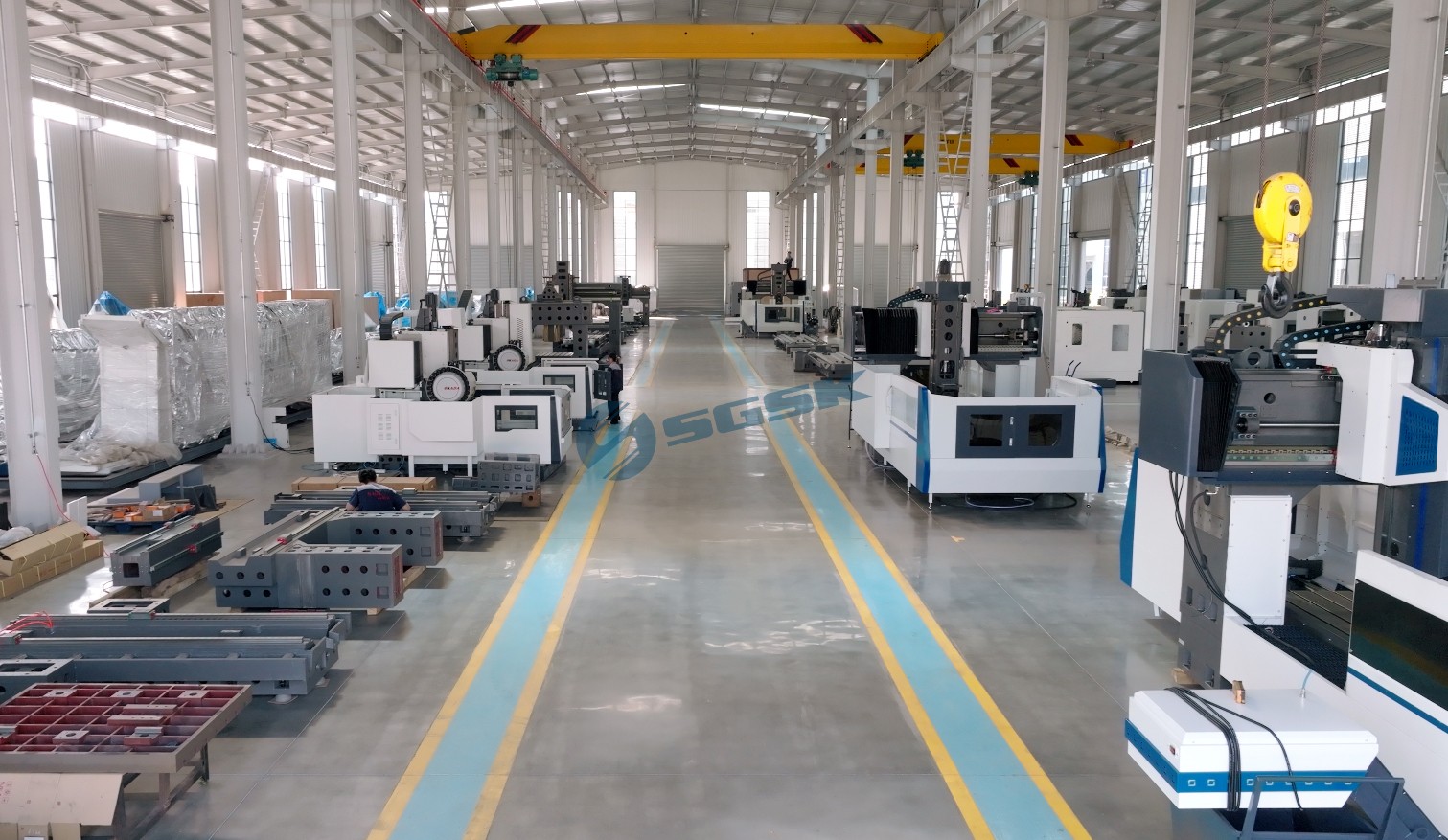
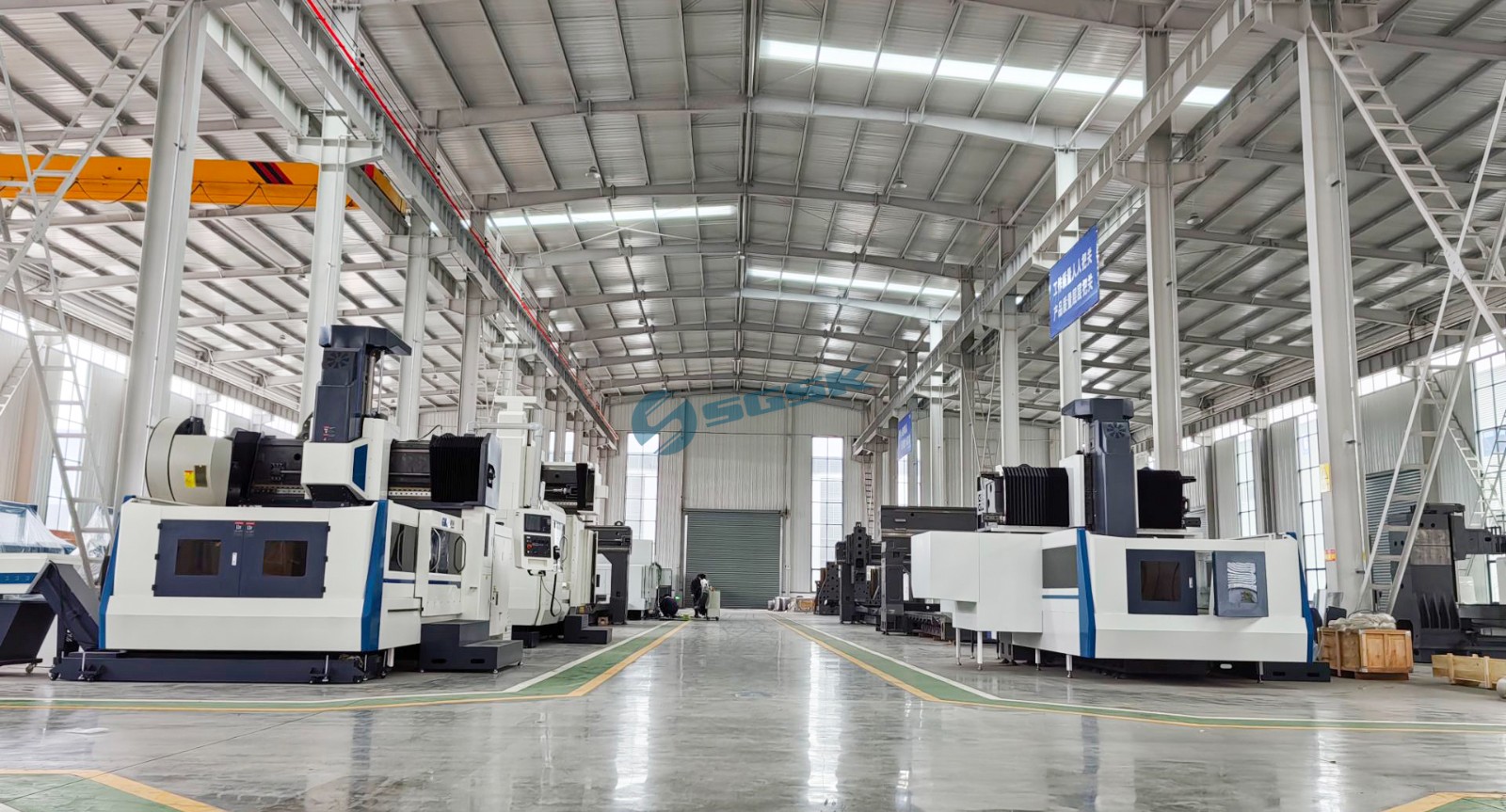
SGSK Machine Tool has built its own high-strength HT300 resin sand casting workshop with an annual production capacity of 6,000 tons.
All gantry bases and columns undergo "double aging treatment" (12 hours of 650℃ holding + natural cooling + 8 hours of secondary 300℃ holding),
and are equipped with laser trackers for micron-level curvature compensation scraping of the guide rail mounting surfaces.
In a 2024 spot check by the National Machine Tool Quality Supervision and Inspection Center,
its XK2632 gantry machining center achieved a guide rail straightness retention of 0.012mm/2000mm after 5000 hours of trouble-free operation, exceeding the GB/T 19362.1-2022 standard limit by 42%.
III. Service is not after-sales remedy, but pre-emptive embedded engineering support.
The biggest pain point for high-end manufacturing users is not equipment failure, but process adaptation failure.
A high-speed rail brake disc manufacturer experienced frequent vibrations during deep cavity groove machining due to insufficient Z-axis acceleration in its gantry equipment,
ultimately leading to the replacement with imported equipment.
SGSK Machine Tools implements a "pre-process collaborative mechanism":
Upon contract signing, a process engineer with over 10 years of experience in aerospace structural component machining is immediately dispatched to the factory to collaborate with the client in building a material cutting database,
simulating fixture interference, and performing multi-process cycle time balance analysis.
Of the 47 gantry mills delivered in the past three years, 92% achieved "first-piece qualification," shortening the production line introduction cycle by an average of 23 days.
Its proprietary "Gantry Dynamic Load Simulation Platform" can reproduce the client's actual cutting force spectrum before shipment, allowing for targeted optimization of the beam stiffener topology.
IV. Clarifying the Essence of "Intelligence": Data Acquisition Does Not Equal Intelligent Decision-Making
The current market is saturated with concepts like "AI adaptive" and "cloud diagnostics,"
but most only achieve vibration sensor data uploads, lacking deep coupling with PLC underlying logic, G-code parsing engines, and tool wear models.
The "Gantry Intelligent Control Hub," developed in collaboration between SGSK Machine Tool and the Digital Manufacturing Equipment Laboratory of Huazhong University of Science and Technology,
possesses three core capabilities: real-time analysis of NC program instruction streams to predict transient impacts on the gantry structure from the next process;
inversion of tool micro-chipping status based on acoustic emission signals, achieving a warning accuracy rate of 89.7%;
and automatic correction of coordinate system zero-point drift based on changes in ambient temperature, humidity, and coolant conductivity.
This system has been validated on the large hydraulic support valve body production line of XCMG Group, increasing effective cutting time per shift by 18.3% and eliminating unplanned downtime.
V. Regional Manufacturing Genes Determine the Underlying Product Logic
Tengzhou, not a traditional heavy industry base, has become the county with the highest output value of small and medium-sized machine tools in China.
Its core advantage lies in its flexible manufacturing ecosystem of "small batches, multiple varieties, and rapid iteration."
SGSK Machine Tools fully leverages the resources of 37 specialized and innovative supporting enterprises in the region.
VI. Rejecting "One-Time Transactions," Building a Closed-Loop Value System Throughout the Entire Lifecycle
SGSK Machine Tools has launched the "Gantry Health Passport" system: each machine has a built-in unique ID chip that records all 237 process data points from blank casting,
heat treatment, precision assembly, final inspection and testing to on-site operation at the customer's site;
customers can access the remaining life prediction model of key components in real time through an encrypted port;
after five years of service, the company buys back the old machine at 35% of the original purchase price, offsetting it against the next generation model.
This model has covered 217 manufacturing enterprises in North and East China, with 83% of customers completing secondary purchases.
Practice shows that when equipment manufacturers truly assume responsibility for the entire asset lifecycle management, "
avoiding pitfalls" shifts from passive defense to proactive value co-creation.
Navigation
Tel.: +86 632 5083 879
Mob.: +86 151 6326 5369
Wechat: +86 151 6326 5369
E-mail: info@gskequipment.com
WhatsApp: +86 151 6326 5369