08. 24, 2026
How to choose lead screws and linear guides for vertical machining centers? What are the differences between linear guides and hardened guides?
Shandong GSK CNC Equipment Co., Ltd. is located in Tengzhou, a major manufacturing town in southern Shandong.
This area has been known since ancient times as the "Hometown of Mozi, the Sage of Science,"
and in modern times it is renowned for its precision machinery industry cluster—the city boasts over 100 large-scale machine tool enterprises,
accounting for one-third of Shandong's casting production capacity, and possesses mature local capabilities in heat treatment, precision grinding, and CNC system integration.
This industrial environment allows SGSK CNC machine tools to adhere to both technical rationality
and a deep understanding of users' actual working conditions when selecting core components for vertical machining centers.
The lead screw and guide rail are the physical anchor points for the motion accuracy and lifespan of a vertical machining center.
Users often equate "linear guide" with "fast" and simply understand "hardened guide" as "heavy," thus falling into a narrow cognitive trap.
The 2023 "Annual Fault Analysis Report of the China Machine Tool & Tool Builders' Association" shows that among 372 failed vertical machining centers in East China,
41% of positioning errors stemmed from lead screw preload failure,
and 29% of crawling phenomena were caused by improper guide rail lubrication design and load matching, rather than the quality of the guide rail type itself.
This illustrates that selection is not simply about labeling, but about establishing a three-dimensional response chain encompassing "structure-process-maintenance".
The selection of lead screws must directly address three rigid constraints: peak load, acceleration requirements, and thermal deformation tolerance.
SGSK CNC machine tools generally use C3-grade double-nut preloaded ball screws for the Z-axis,
coupled with fixed support structures at both ends to suppress axial thermal elongation;
while the X/Y axes are configured according to machine model—the economical VMC850 comes standard with a φ40mm lead screw,
while the heavy-duty VMC1680 upgrades to a φ50mm lead screw, reducing the pitch from 10mm to 8mm to improve rigidity and reduce feed rate fluctuations per revolution.
Crucially, all lead screws undergo 200 hours of constant-temperature running-in and individual calibration with a laser interferometer, controlling the runout error to within 3μm.
This is not about parameter stacking, but about ensuring the lead screw maintains a micron-level position feedback closed loop even under sudden changes in cutting force.
The fundamental difference between linear guides and rigid guides lies in their load-bearing methods and damping characteristics.
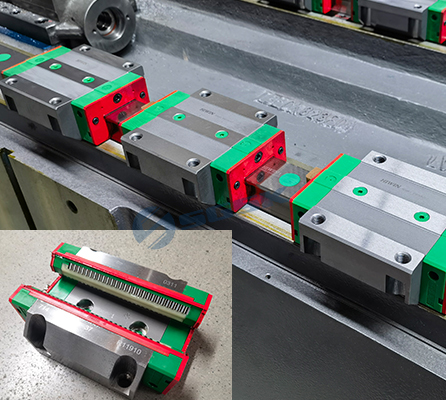
Linear guides achieve low-friction guidance using rolling elements, making them suitable for high-speed precision machining.
Hardened guides rely on an oil film on the sliding surface for load bearing, offering superior shock resistance and vibration absorption.
However, a long-overlooked fact exists in the industry: the so-called "high rigidity of hardened guides" only holds true under static or low-speed conditions.
When the spindle speed exceeds 8000 rpm, the oil film in the sliding pair of hardened guides is prone to rupture, increasing backlash;
while high-quality linear guides, with proper preload, exhibit more stable dynamic rigidity.
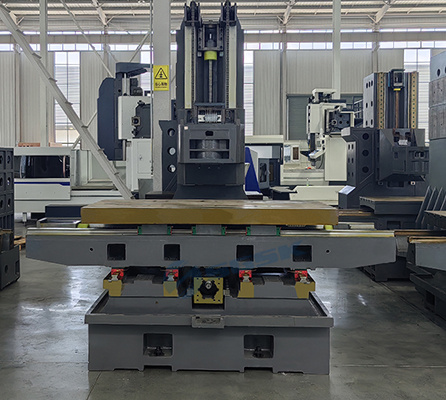
SGSK CNC machine tools in the VMC1165 series utilize original THK P-grade linear guides, combined with a self-developed trapezoidal preload structure,
achieving a dynamic rigidity of 32 N/μm in the X/Y directions, a 17% improvement over similar hardened guide solutions.
This is not a replacement, but rather a process adaptation—linear guides are essential for machining thin-walled aluminum alloy parts,
while the continuous torsional resistance of hardened guides is required for rough milling of large molds.
Linear guides are suitable for high-speed drilling, mirror milling, and light-load continuous machining.
Typical workpieces include mobile phone frames and aerospace bracket connectors.
Hard rails are suitable for rough and finish machining of large cast iron parts, intermittent cutting, and heavy-load boring.
Typical workpieces include gearbox housings and hydraulic valve blocks.
Hybrid structure practice: SGSK's VMC1370 uses linear guides on the X/Y axes to ensure positioning accuracy,
while the Z-axis uses hardened steel-insulated hard rails to balance vertical rigidity and thermal stability.
What users truly need is not a binary answer of "linear guides or hard rails," but rather verifiable working condition mapping capabilities.
SGSK's CNC machine tool technical team provides a "Guide-Screw Matching Working Condition Table" for each vertical machining center,
listing recommended preload, lubrication cycles,
and temperature rise thresholds under different material, tool diameter, and depth of cut conditions.
For example, when machining 45# steel tempered parts (HRC28) with a cutting depth of 3.5mm,
if a φ12mm carbide end mill is used, the linear guide rail needs to maintain a preload of 0.02mm,
and 3ml of ISO VG68 guide rail oil needs to be added every 8 hours;
while under the same conditions, the continuity of the oil film on the scraped surface of the hardened guide rail needs to be checked daily.
These data come from the actual test logs of 23 trial cutting machines at the Tengzhou factory over a total of 17 months, not from simulations.
Hidden costs in procurement decisions are often underestimated.
A certain automotive parts factory once purchased linear guide end mills at a low price without simultaneously upgrading the cooling system,
resulting in a lead screw temperature rise exceeding 12℃.
After six months, the repeatability accuracy decreased to ±0.015mm, and the repair cost exceeded the original value of the equipment by 30%.
SGSK Machine Tools integrates a closed-loop temperature monitoring module at the factory, with a built-in PT100 sensor in the lead screw bearing housing.
The guide rail lubrication pump pressure is fed back to the CNC system in real time, automatically reducing speed and triggering an alarm in case of abnormalities.
This embedded reliability design transforms maintenance from "post-event repair" to "pre-event intervention."
Within its local service radius in SGSK CNC machine tool provides 72-hour on-site diagnostic response and maintains a spare parts inventory of 32 types of lead screws,
and 19 types of guide rails and sliders to prevent downtime due to single-point failures.
Choosing lead screws and guide rails is essentially choosing a manufacturing philosophy:
is it about pursuing peak performance on the parameter list, or building process tolerance throughout the entire lifecycle?
SGSK CNC machine tools don't push "the latest technology," but only provide deterministic solutions validated through thousands of cutting operations in the Tengzhou workshop.
When a VMC1270 runs continuously on a customer's production line for 42 months without lead screw replacement,
and when a hardened guide rail model maintains no significant wear on the guide rail surface for five years in the dusty environment of a foundry,
these facts are more convincing than any advertising claims.
True precision isn't in the factory inspection report, but in the dimensional tolerance of the first workpiece after the user starts the machine each day.
Shandong GSK CNC Equipment Co., Ltd. now offers in-depth consultation services for the selection of core components for vertical machining centers.
Users can submit typical machining part drawings, cutting parameter records, and existing equipment fault logs from the past three years.
The technical team will issue a "Moving Component Matching Optimization Proposal" within 5 working days, including specific models, installation points,
and the first year's maintenance schedule.
This service has covered 147 manufacturing enterprises in Shandong, Jiangsu, and Zhejiang provinces, increasing the effective operating rate of equipment by an average of 11.3%.
Navigation
Tel.: +86 632 5083 879
Mob.: +86 151 6326 5369
Wechat: +86 151 6326 5369
E-mail: info@gskequipment.com
WhatsApp: +86 151 6326 5369